April 9, 2010

Painted Hunting Dog

We were incredibly fortunate while in Samburu to see a pack of painted hunting dogs warming up for their morning. We saw them run down a hill and were able to follow them for at least half an hour before they hunkered down in a dried up river and were largely hidden from view.
They are very social pack animals with hunting habits similar to wolves. By hunting cooperatively in a group and covering large distances they manage to have an 80% hunting success rate compared to the 30% or less common to lions and the like.
Our tour operator had only seen them once before in his 20 some visits to Kenya, and our driver had only seen them once as well in 9 years of work, so we were incredibly lucky to see them so well in our few days in Samburu. These beautiful animals need a very large area of land to hunt in the loss of their habitat combined with competition against larger lions and hyenas in that smaller space has made them critically endangered.

April 7, 2010

Warthogs

Warthogs certainly win the contest for "so ugly it wraps around to cute again." We saw them throughout our trip, primarily in the open grasslands but occasionally in the forest. Though these pictures sometimes make them look small and cute, the males can get up to 300+ lbs and be more than a meter long.
They use their tusks for defense, to duel between males, and to root for food. They are quite omnivorous and will eat all manner of plant life along with some carrion.
Like many other prey animals in the savanna, the warthog seems to survive by sheer numbers. A typical litter will apparently begin with up to 10 piglets and that number will gradually whittle down due to various predators, but enough survive to repeat the process. When startled they all perk up their tails like little flags and trot away in single file, which is often referred to as "The Kenyan Express."

April 5, 2010

Regal Eagles

We saw quite a few kinds of eagles throughout our trip. Many of them are very similar and can be quite tricky to tell apart ("Say, was the edge of its mouth behind its eye or infront of its eye?") so I have selected a few of the more distinct birds to show some of the variety that is out there. First off is a Tawny Eagle, one of the most common birds of prey that we say. I managed to nab this one just as it was taking flight and I've always been a bit smug about it.
Our boat ride on Lake Naivasha afforded us some opportunities to see African Fish Eagles in action. Although not very experienced at it, our guides would throw caught fish into the water near our boat and the eagles would dive down and snatch them out of the water, resulting in some nice action pictures and slow motion footage.
Rounding out the set, this Crested Eagle has a rather charming bouffant tuft of feathers on the top of its head. Unfortunately we only saw them at roadsides with harsh backlighting and at Lake Manyara with too much shadow and distance, so our pictures of this unique bird are not as nice as they could have been.

April 4, 2010

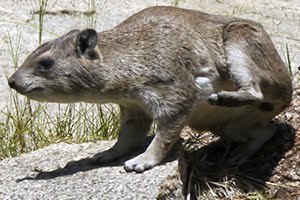
The Savage Majesty of the Hyrax

The hyrax is an exceedingly cute mammal around the size of a cat which seems to live exclusively at safari lodges. There are several types in Kenya and Tanzania but we only saw the rock hyrax (although on several nights at Sweetwaters we could hear tree hyraxes shrieking at around 4am).
Scientists which clearly understand the evidence more than myself have determined that they share common ancestors with elephants and dugongs. Something about toenails, tusks and bone structure. I'll take them on their word since it makes hyraxes even more awesome, but I never would have guessed it. They perpetually look like they're smiling, so maybe they are as pleased by this as factoid I am.
They also come in baby form and are even more ridiculously cute then. We're honestly quite surprised that they've never been a fad pet and I think when I tire of CGI I'll try and settle down with a hyrax ranch somewhere. Apparently they have a surprisingly long gestation period and take a long time to mature, so maybe that will prove to be more trouble than its worth... either way they are exceedingly adorable when they're smallest.

April 3, 2010

The Maasai Mara

The final place we visited in our tour was the Maasai Mara which makes up the northern tip of the Serengeti in Kenya. Every stereotype about Africa that Disney brought to The Lion King and nearly every documentary about migration has its roots in this preserve. The word Mara in the language of the Maasai people means 'spotted' and the picture below illustrates how the savanna is speckled with vegetation as far as the eye can see.
The Maasai Mara is also the location of the Mara River which is the famous crossing made by the wildebeest migration every year as millions of the animals come north from the Serengeti to graze and mate. The waters were quite low when we were there, but the banks looked quite rocky and treacherous as it was and neither of us envied the wildebeest their crossing.
As there's so much to see and do there, we had 5 days there and in that time we had wonderful encounters with elephants, lions, cheetahs, topi, leopard, warthogs, jackals, hippos, cape buffalo, dwarf mongeese, and birds of all shapes and sizes.

April 2, 2010

Good Gnus

We saw massive herds of gnus (or wildebeest, whichever you prefer) in Ndutu and they have been described as being animals made up of left-over spare parts. Goofy looking to us or not, the design clearly works for them as every year millions of them migrate from the Maasai Mara to the Serengeti.
For several days we were surrounded by thousands of these fellows every time we left the lodge and every single creature that could eat them was doing very well for themselves. Some fell prey to cheetahs or hyenas, others had died of sickness and a great many had gotten stuck in the mud of a nearby lake and drowned. But gnus succeed by sheer volume and despite the individual losses, the herds were massive and healthy.
They were starting to give birth in the last day we were there so we saw a few babies but not as many as were to come. Gnus give birth all at once and once again simply overwhelm predators with numbers that cannot be dented by any hunting. The babies we saw were less than 5 hours old and were already dry and learning to run so there's certainly a steep learning curve to being a gnu.

April 1, 2010

Sweetwaters

At the base of Mount Kenya, Sweetwaters is a private nature preserve (rather than a park) which was enclosed by fences and had quite a varied range of terrains to explore. As a preserve it also had a few enclosures of animals which were protected but not indigenous such as a troop of chimpanzees which Jane Goodall had setup a refuge for.
Because it was fenced and fully enclosed, Sweetwaters also felt a little more restrained than many of the parks we had visited, particularly with regards to big cats. We did have a nice encounter with some cheetahs on one drive, but they were pretty scarce throughout. That didn't stop us from seeing some nice elephants, go-away birds, crowned cranes, black rhinos (one of which Kathryn got to feed), hippos, bush babies, and an assortment of gazelles.
Believe it or not, by this point in the trip we had nearly had megafauna overload and it was getting increasingly difficult to amaze us with new displays of animals, but luckily some of the best views were to be had at the waterhole right in front of our tents (shown below). From here we could watch giraffes, rhinos, impala, waterbuck, zebras and warthogs come in for a drink and a mudbath without having to do all that arduous driving and standing we were used to.