May 4, 2025

Maritime Oddies of Chuo City

Chuo is one of the five special wards of Tokyo, with a resident population of 170,000 that swells to 650,000 due to the influx of daytime workers. With its proximity to the ocean and canals in use since the 1650s, Chuo has a rich maritime history, which helps contextualize our handful of unusual discoveries along the Takeshiba pier.

 The Passenger Ship Terminal is a departure point for Izu and Ogasaware islands, with an overarching nautical theme, including this mast and rigging surrounded by walkways and elevated trains. A variety of sparrows and crows made for good nature sightings in the area as we warmed up for our day's walk.

Maintaining tidal and rainfall water levels steady since 1970, the Hama-rikyu drainage pump station is one of 4 key water management facilities and also totally looks like something out of Dune.
For those of you wondering what a Japanese nightclub owned by Jules Verne would have looked like (you know who you are) we have great news! The 'Hotaluna' is the second of three vessels designed by anime creator Leiji Matsumoto (note to my mum - he ALSO created "Albator" which I used to watch on the French channel in the 1980s - small world) which can carry up to 120 passengers for cruises around Tokyo harbour.


April 20, 2025

Hol Chan

 Hol Chan, Mayan for “little channel,” covers 19km2 of coral reefs, seagrass beds, and mangrove forest near San Pedro. Established during the 1990s during a time of increasing tourism and declining fishing industry, the area covers 4 zones which have differing biomes and permitted activities.

Generations of fisherman cleaning their gear while returning to port has created an unexpected gathering place of sharks and stingrays, known locally as Shark Ray Alley, where local tour guides feed the animals as tourists watch from nearby.
Hol Chan Cut is open to the sea beyond the reef, enabling marine creatures to travel between the interior and exterior of the reef. This concentrates wildlife with 160 species of fish, 40 types of coral, and 3 species of sea turtle in addition to numerous rays, lobsters, eels, and anenomes.

April 13, 2025

San Pedro

Ambergris Caye is the largest island in Belize, running 40m long but only 1.6km wide. Inhabited by the Maya in pre-Columbian times, the island was also popular with 17th century whalers, gradually turning to tourism in the early 1970s. Modern ‘San Pedranos’ are of Mexican descent with some Creole influences and it is said that you are not a true San Pedrano if you don’t know how to fish.

There are a number of settlements and resorts scattered around, but San Pedro Town is the only sizable town with an estimated population of 20,000. The majority of the island is set aside for national parks, further limiting the availability of real estate. The restricted space make car culture non-feasible, with that void being filled by golf carts. Access to the island is easily achieved either by domestic flights or a ferry service from Belize City.
Many of the roads are gravel and in perpetual need of re-grading, so a conventional golf cart won’t do the trick, these are some serious vehicles for a wide-range of conditions.

Steven arranged to borrow a golf cart from a friend in his condo complex and showed us a great time by shuttling us throughout San Pedro. As a trio we fit quickly and easily into our borrowed vehicle to zip from attraction to attraction.
 Between the Iguana Sanctuary, feeding tarpon in the marina, Garifuna culture, animal shelter, and the myriad number of restaurants, bars, distilleries, and shops in town we always had somewhere to be going and something different to enjoy.

April 6, 2025

Mexico Rock

The Belize Barrier Reef is a 300km section of the 900km long Mesoamerican Barrier Reef, the second largest coral reef system in the world, which Charles Darwin described as “the most remarkable reef in the West Indies” in 1842. With only 10% of the reef properly researched, it is already a recorded home to 100 species of coral and 500 species of fish and was declared a World Heritage Site in 1996.

Mexico Rocks is a shallow complex of some 100 clustered patch reefs along a limestone ridge. Popular with both snorkelers and SCUBA divers it was recommended for preservation in 1978 and officially recognized in 2015.

Belize was the first country in the world to completely ban bottom trawling in 2010 and in 2015 banned offshore drilling within 1k of the reef. Despite these measures it suffers the same risks as all reefs and an estimated 40% has already been damaged by human impact.
In addition to environmental damage, much of the reef is also suffering from invasive Lionfish. With a voracious appetite, venomous spines, and no natural predators, these fish are taking a significant toll on local species. Fortunately the people of Belize are actively taking steps to curtail their numbers with bounties for local fisherman and eager offers to take tourists spear fishing with civeche for dinner.

March 30, 2025

Tarpon Feeding

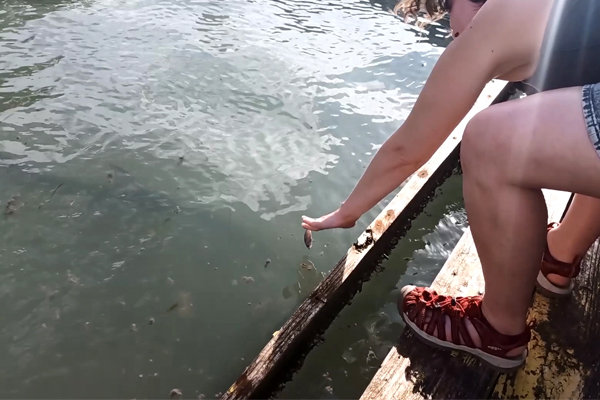
Steven took us to special places in Belize, both in San Pedro and Caye Caulker, where you can buy a bag of sardines and hand feed the local tarpon. Growing 4-8 feet long and weighing 60 to 280lbs, you have to be a little extra cautious in this process, just keep your palms flat as they really burst to the surface with force.

These fish are interesting for a number of reasons. Their modified swim bladders allow them to breathe air, surviving in oxygen-poor waters of brackish marshes but also leaving them tethered to the surface to breathe.

This flexibility around air also lets them take large gulps for short bursts of energy such as lunging for sardines, and this same jumping makes them popular game fish, although they are typically released afterwards as their flavour is not great.

We had our insta360 camera and an underwater housing along on this trip as well to share this tarpons-eye view of their feeding group under our boat.

March 23, 2025

Secret Beach

Given how widely advertized it is right from the airport, Secret Beach is certainly more of a “wink” secret than an unknown gem. In fact, it is possibly the most visited area of Ambergris Caye and perhaps all of Belize.

Until very recently, all development on Ambergris Caye was along the (eastern) reef side as the fishing, diving, and trade winds that brought people to the island were all there. 

However, in the last decade developers have built a road through the mangrove lagoons that form the centre of the island, making the (western) leeward side more accessible. Currently there are a number of scattered residences being built up along this road, but whether they are foolhardy or ahead of the curve remains to be seen.

 Once on site at Secret Beach there are a number of venues to choose from but the general theme of the spot is consistent: swim, eat/drink, sunscreen, repeat.

We took an afternoon trip by golf cart across the island and down to the crystal waters for a mellow afternoon of floating and eating nachos in a semi-submerged palapa. Despite my best efforts I am not really a natural-born loafer so after half an hour relaxed in the sun I was ready to be off on our next adventure.

Fortunately, the drive to and from the beach was a big enough part of the outing to fill out the day and provide some fun stops and detours to along the way.

March 16, 2025

Cockscomb Basin

Established in 1986 and deriving its name from the nearby mountain ridge which (to some) resembles a roosters comb, Cockscomb Basin Wildlife Sanctuary is 400 square kilometers of rainforest. One of its key reasons for creation was to preserve jaguar habitat, and it remains on of the premiere sites for these cats in the world.

With only a single morning of hiking near the entrance, it is unsurprising that this is as close to a jaguar as we got.

The park consists of two water basins (west and east) with access and trails getting more difficult the further west you venture. Wildlife highlights in our self-guided hike include coati, aracari, toucans and guans. There were also some tracks we believed to have been recently made by a tapir, but that was as close as we came to sighting one.

One guaranteed sighting in the park is this crashed plane, which occurred as a result of an attempted landing on an access road during a thunderstorm in the early 1980s. A researcher used this plane for tracking jaguars via radio collars to learn more about their behaviour before the park was formed, and it remained an artifact of his efforts when the park opened.


Fortunately, none of the pilot, photographer and researcher on board at the time were seriously injured in the crash.